RETURN

A STRANGE STATEMENT

Beginning through a novel premise: there is a figure who is bound by the theatrical stage.

An actor, an orator, an extra, a prop, a body, a subject framed by a proscenium existing between the dressing room and its curtain. Isolated, they have been sequestered to perform. To enact specific scenes, recite the given scripts, becoming a stand-in under an unknown agency in a theatre absent of any spectators. As if rehearsing for a play that will never open, waiting for a director’s cue that may never arrive, or facing a curtain that shouldn’t be raised, this dramatic world is all the performer knows. 

A character of gradual corrosion, the figures' interiority is established through their absences, what is discarded or withdrawn from direction. As each act further hollows their interiority, they are dressed with a disidentification. To be oneself less, yet, incapable of fully revoking. Even when the subject's constitution is corpse and carted away, its presence still violates the status of its surroundings. Traces lurk, rather injure, as the actor is replaced, reinstated, reified, and dissipated into the background. Their lack exposed, spilling on stage only then to be absorbed by a coercive gap which inscribes itself as an antagonist mise-en-scène. Divorcing the actor’s world to hold existence without clear destinations. Abiding by the theatrical interval, they are paused in impasse, posed in an ending that mustn't.

Scenes echoing, impersonating an external world have been truncated, transgressed into rarefied sites of exception. Provocative of an unreconciled world where vacancy as disparity acts as a suspension, a cut, redolent of a change of order, an unraveling law of the land, another world becoming dormant. What remains, what is residual, is theatrical evidence. Released material of illegitimate posters, apparent scripts, signed contracts and indictment reports, divisions of scenography, relinquished props, seized photographs, private audio and film recordings. Documentation of the extra-juridical which alone serves to distance us from the original events. As a  denial to the anti-spectacle, we as mere witnesses, glimpse through a disquieting frame of a world that was and is no longer.

While the impulse to hunt for motive, prior meaning, to anchor this theatrical servitude of aesthetic and ethical liquidation, is, in effect, discoloured, exploited, spoiled by the director's divorced lens. As any act produced, its remnants unclassified, or leaked, reviewing the evidence impairs its predecessor, interrogates presuppositions and discredits where and when this drama-affected scenery, the subject-actor, the nominal authority and their timeless bondage, might remain just for show.
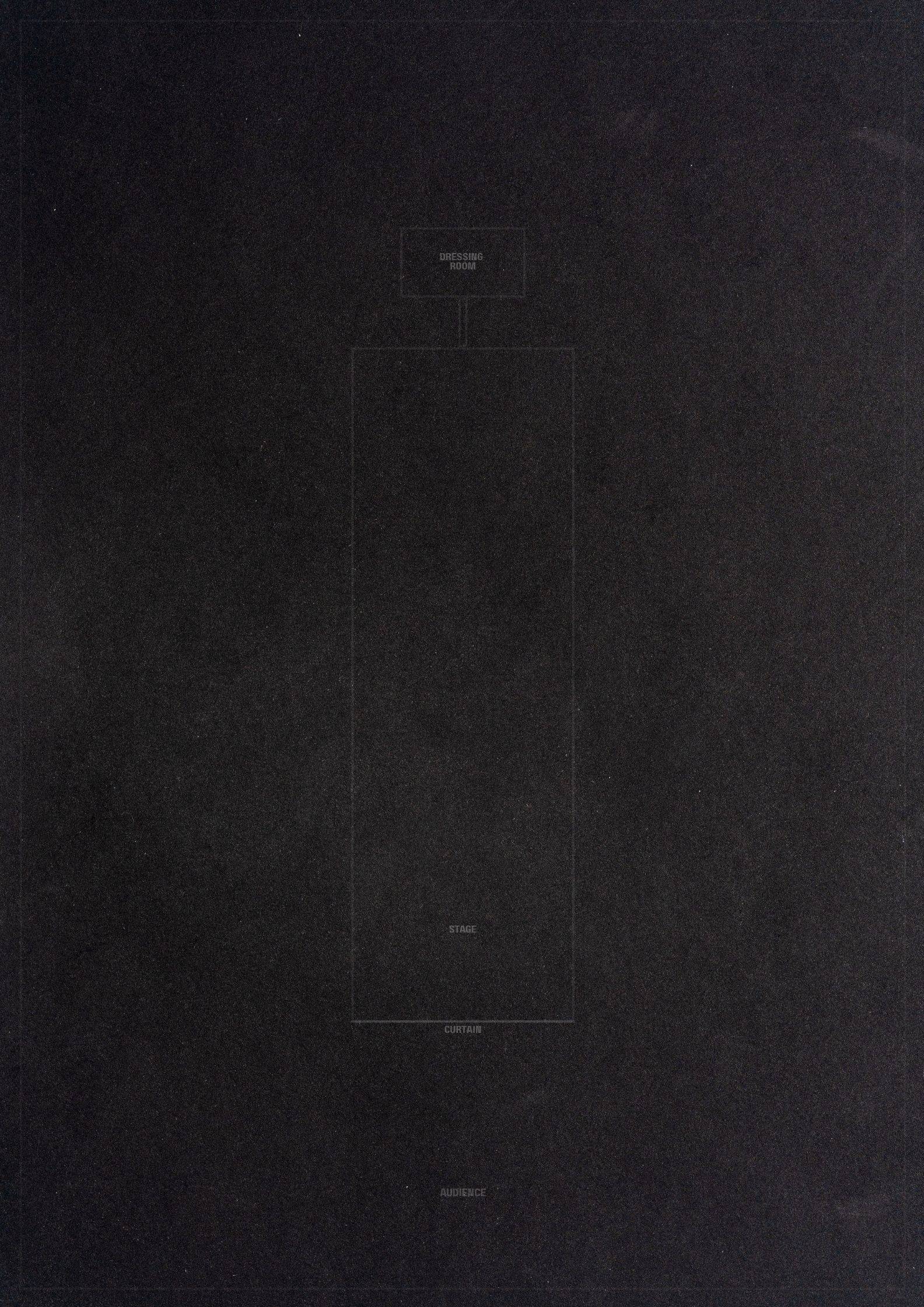
Behind the scenes, this conceptual world concentrates Matthew Lloyd’s work as a drama that is cinematically alluring, albeit strangely inaccessible. As if witnessing a secret ceremony, or glimpsing beyond the restricted cordon. The work, quarantined in action and indifferent to spectatorship, keeps the observer at a disconcerting separation yet without lessening the lure to stare, listen, and move more closely.

Lloyd’s work is a crime, and the stage, the scene of. Primarily due to how their theatre inhabits itself as an estranged site of exception. A moribund underworld whose framework is being ambiguously unsettled, wrapped by scripted severances. This chasm-theatre, turned prison, courtroom, lecture hall, and comedic stage, produces what has seemingly been collapsed (perhaps fallen from the outside world) and licensed its omissions to be excavated in a deficient play. All the while, the original caveat for such dramatic exceptions, the official announcement of violation, remains but a shadow looming throughout the stage, fogging this theatrical universe as indeterminate and liminal. 

Deceptive, dislocating acts are to be articulated as intervals, cuts, that have become somewhat unmoored from their script, unclassified serial events of (veri)similitudes and works which narrow the truth of the event with its edges of fiction. Here, we are reminded about the plight of representations of when our coordinations of what constitutes reality begin to rupture, become strange. In the vicinity of what should remain prohibited, excluded in our composed framework, we find ourselves confronting a vacancy which emerges, rather returns, as the edge of the inconceivable starts to fade. In this regard, the work, the ‘crime’, remains in question, abiding into the interruption, the extralegal, the gap itself. Paused at the verge of the Real.

Apropo to the philosophy of its maker, this theatre is a spoiled psychogeographic territory. An eerie maze of thinking, whereby fictional acts have inherited this incongruity and thus come into being. Eliciting semblances that have, allegedly, emerged from actual catastrophes. Backdrops, theoretically speaking, are soaked with barbarity, position bankrupt characters, discarded scenery, and vacuous props to frame the stage and act out: the ethical consequences of the unrepresentable; the autonomous plight of the unspeakable; a subject's destitution to ground subjectivity; the aesthetic disavowal of a symbolic-order. 

And yet, what informs the work's unsettling choreography of the scene is the documentation of their prohibitions. Initially, due to Lloyd’s performances lacking theatrical relief. When pieces, objects, and scenarios exist, literally out of place, fractured from their own set, they subsist as wary, uncustomary protagonists that dare our dramatic attention. Moreover, is how these abstruse vestiges of unseen dramas are lensed through the gaze of a disaffected director. Although seemingly protected by the symbolic curtain from confronting what cannot be fully penetrated, we, as the undesirable witness, are radically beholden to watch through and as the subjectivity of an impresario, of which, in its own right, is devoid and unidentifiable. 

Whilst an impounded actor of impersonal character is directed to perform somewhere between a subject of lack, a bodiless form, or that of the living-dead. A subject with a declining subjectivity. Their backstory a blind spot, but whose markings of authorship remain at large and deeply absorbed by a tension that disrupts and preys on their selfhood. Such theatrical conflict between the figure and background is invariably staged as ontologically one. Being the subject-actor emerges, retreats and rests into, from, or as this dramatic cavity; neither property becomes fully swallowed. Absences, pieces, signs, clues hold on: a speechless body, an acousmatic voice, a blank signature, a censored statement, disembodied attire, an empty assembly of chairs. Here, the preservation of the whole of extinction is, again, incomplete, suspended and cut from reaching its end, from ending its end. 

Outside its dramatic set and off the record, Lloyd’s theatrocracy focuses when they are assigned being a misgiving director against their own artist self and work. In striving to establish their own laws between artist and artwork, doubling themselves as a subject of Other, being a subject-object to the spectacle; allowing haunting authorities to restructure identity and artistic obligations; adopting the position of a curator of an artist who creates, or more accurately, as a writer about a director who manufactures an actor to perform. Through a series of networked divorces, Lloyd takes a hard detachment from themselves for an earnest (meta)account on the artist condition. By placing the artist in custody, and eliciting their actions to be probed and the subtext throughout their detention, where inauthenticity and alienation are virtues, discloses a critique on authority and authorship in the status of artist subjectivity and autonomy. 

An interrogation led by Lloyd to set up themselves, builds a case that charges how artists embrace and abandon responsibility, effect, and fidelity to a world perished from, or towards, or even regretful of being associated with. An unexpected route into art’s theoretical foundations articulates this hermetic ivory-theatre, with no exits, trap doors and a revoked audience, as a radical grandstand in which art and artist is perturbed by itself. 

Once extracted from its histrionic beginnings and detained for public inspection. The exhibition in Lloyd’s universe operates inherently as a site of unfolding, where new information, a new testimony, leaked footage or another document has been published and come into the so-called spotlight. Explicitly interrupting the exhibition as a confidential scene of reproduction through a forensic narrative. In a reviewable setting, Lloyd’s installations become suggestive of detectives recovering evidence from theatrical ruins or material disclosure to solicit leads and public awareness. 

Held hostage with little plea, the gallery succumbs to scenographic apparatuses to besiege and mourn the exhibition form. Engulfed by charcoal-toned curtains that shape private enclosures, subdued stage lighting reveals what otherwise remains in darkness; objects defended by vitrines or velour ropes become an internal affair. While sets, unkneeling to the white cubes’ architectural respects, remain at their full-theatrical-scale, as concealed sounds of audience murmurs or fragments of a show’s score cross-contaminate between objects and artifacts.   

Unearthing this unclassified evidence within the exhibition articulates the work quite inadmissible and illegible due to the proposition of being from the Other Scene, a private conception, so to speak. Reported as being ripped from its original world and exiled into the exhibition space, Lloyd’s work diverges from being automatically enlightened by the exhibition form and its prescribed public. Maintaining its theatrical spatial separations by not allowing observers to get too close to the artefacts. The work reassures a strange autonomy through disturbing the status between viewers of objects, locating its presence in a spectacle of ambiguous distance, all the while re-attaching itself to another foreign legislation.

As the work’s admittance into public record, into the exhibition, arrives with avowed indications, markings of corruption and unease preservation about its history. Tampered evidence without time periods, absence of biographical information, muted voices, disposed sets, redacted directors and ransom notes,misleading posters, oddly coalesced testimonies, scripts, and contracts intrinsically swells with suspicion that revelatory information has been removed. The question, for whom, out of protection for the sovereign theatre, the unidentifiable director, the subject-actor, or the symbolic/actual audience, remains unclear. 

What is clear is that this trail of ML, wishes to retain a seclusion and dignity by such invalidness and exits. That just enough information can penetrate, that is, soak through, even if for good or ill, it stains. In this regard, once in the jury-eye of the public, Lloyd’s acts can be better understood as cutscenes. Amputated pieces of a play, separated restricted files of internal conflicts and external denials, that, by its disclosure, undercuts, impoverishing the larger case at hand. If indeed there will ever be one to be found.

As the disassociated chain of evidence mounts and perverts. On the stand, the work forges an audience of sleuths into a deadlock over the cause of this incessant (in)subordination, along with its staged unease and false climaxes. But the dissensus this adheres to, denying witnesses complete access and exhibiting only that which corrupts, contempting its narratology. The work ultimately offers an unfamiliar, but intimate expression of how art might prefer to renounce itself towards aesthetic-legislators, the symbolic regime of the gallery, and subsequently art’s constitution.

In the end, Lloyd’s unstraightforward cross-examination is a show-case whose debt isn’t in performing for the white cube or black box, but elsewhere. A suspicious grey-zone, an autonomous locale that is sealed off by curtains, turned away from the world and into an untimely drama. Disquiet, this is where, as observers, Lloyd wants us to wait. That beneath this unescorted portrait of an artist qua dramatist, qua actor, qua art, and back again. The subject-actor, once more, is getting ready to go on stage to commit to the clandestine, expecting their final sentence.